When Everyone Has AI, What's Your Edge?
AI can write your copy, analyze your data, generate your code, and design your slides. It gets cheaper every month and better every quarter. The tools that required a team two years ago now run in a browser tab.
So if everyone has access to the same capability, what separates you? And the more uncomfortable version: if AI can do what you do, does the company still need you at the same level?
That's the fear. Here's why history says it's pointing in the wrong direction.
The Fear Is Rational — and Historically Wrong
The argument is intuitive: AI does more work, companies need fewer people. Supply of output rises, demand for labor falls. Jobs disappear.
It's a reasonable fear. And it's the same fear that greeted the printing press, the steam engine, the assembly line, electrification, and the personal computer. Every single time, the prediction pointed in the right direction for the short term and completely the wrong direction for the long term.
Automation has never reduced total employment. It has systematically destroyed specific job categories and created entirely new ones — at larger scale.
The question isn't whether this pattern repeats with AI. It's whether you understand the mechanism well enough to position yourself on the right side.
Why Supply Overflow Creates Demand
The intuition breaks down here. When technology lowers the cost of producing something, the usual assumption is: same demand, more supply, fewer workers needed.
What actually happens is different.
Lower cost → more supply → lower prices → previously unaffordable use cases become possible → latent demand unlocks → the total market expands dramatically → the expanded market needs people to run it.
This is the Jevons Paradox applied to intelligence. When something becomes more efficient, total consumption of it often increases — not decreases. The efficiency gain doesn't compress demand. It expands the addressable market.
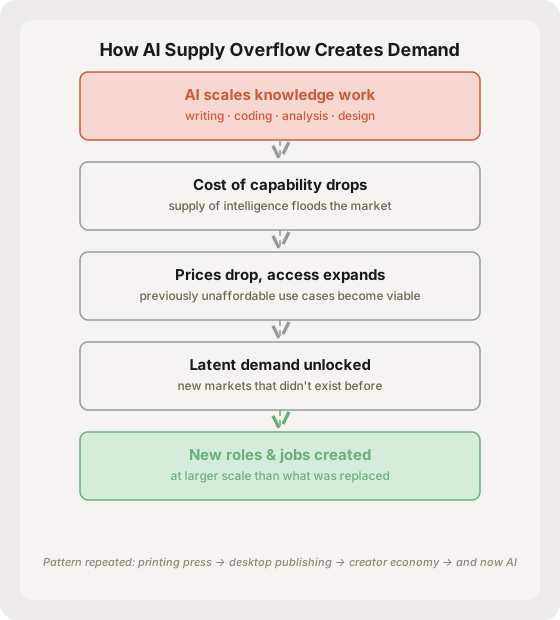
The same pattern ran in every prior wave:
- Desktop publishing (1984): Replaced typesetter jobs. Created graphic design as a mass profession — millions of designers who never existed before.
- YouTube (2005): Video production dropped in cost by orders of magnitude. Instead of fewer videos, there are now 500 hours uploaded every minute. Creator became a career category with 50M+ practitioners.
- AWS (2006): Automated server provisioning, replacing many sysadmin roles. Created DevOps, cloud architecture, and platform engineering — entirely new fields with more total practitioners than the roles they replaced.
AI is running the same playbook. The difference is speed, not direction.
What Becomes Newly Possible
When AI lowers the cost of knowledge work — writing, analysis, coding, design — it doesn't just automate existing tasks. It makes things possible that were previously economically unviable:
- Every small business accessing professional-grade strategy advice
- Every creator producing content in six languages without six translators
- Every founder getting senior engineering patterns without a senior engineer on payroll
- Every individual getting personalized financial or health guidance
Each unlocked use case is a new market. New markets need people to build products, manage relationships, exercise judgment, ensure quality, and navigate edge cases. The job categories that emerge are structurally different — centered on direction and trust rather than raw execution.
The 5 Skills That Actually Matter
Generic advice says "be adaptable." Here's what that concretely means.
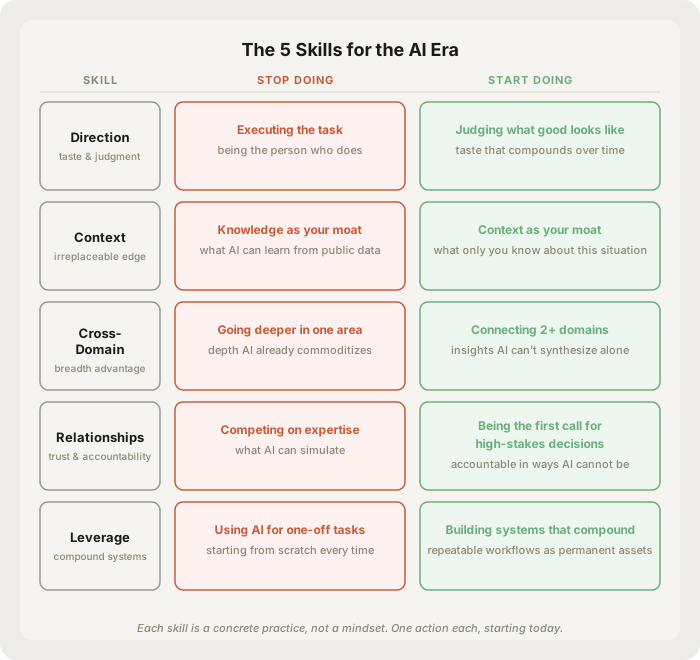
1. Direction Over Execution
AI generates options. The value is in knowing which one is right.
That's taste — a skill built by deliberately studying what excellent looks like in your domain and practicing selection and articulation. It compounds over time and is hard to outsource.
Start today: Next time AI gives you output, don't just accept the best version. Write two sentences explaining what makes it better than the others. Do this 20 times. You're building a judgment muscle.
2. Context Ownership
AI knows everything public. It knows nothing about your company's real constraints, your client's actual fear, or the history that makes one approach impossible and another obvious.
That irreplaceable context is your edge. The person who briefs AI with the right context gets outputs that are qualitatively better than someone who prompts cold — not 10% better, 10x better.
Start today: Write down five things you know about your work that aren't documented anywhere. That's your context inventory. Practice front-loading it into every AI interaction.
3. Cross-Domain Connection
AI has extraordinary depth within a domain. It's weaker at unexpected combinations — the insight from connecting behavioral psychology to product design to distribution strategy.
In a world where depth is commoditized, breadth creates structural advantage.
Start today: Pick one field outside your expertise. Read one article per week from it. After a month, force one insight connecting it to your day job. The discipline of cross-pollination is the skill.
4. Relationship Capital
High-stakes decisions — budget, hiring, strategy, partnerships — still route through human trust. AI can advise. It can't be accountable.
The person who is trusted and visibly accountable will always have a seat at the table. Accountability is underrated. It's also becoming rarer, which makes it more valuable.
Start today: Identify your five most important professional relationships. When did you last add value with no agenda? Schedule one reach-out this week.
5. Leverage Architecture
There's a large difference between using AI for one-off tasks and building systems that consistently produce results. The latter is a compounding asset.
A repeatable AI workflow in your domain outproduces a person who starts from scratch every time — indefinitely. Build the system once; the productivity advantage accumulates.
Start today: Pick one recurring task. Spend two hours turning your best AI interaction into a repeatable template: inputs, prompt structure, quality check. That's your first workflow asset.
The New Scarcity
When everyone has access to capable AI, execution stops being scarce. What becomes scarce is the human layer that makes execution matter:
Judgment about what to build. Context that only comes from relationships. The ability to synthesize across domains. Trust that can't be delegated. Systems that compound over time.
That's the job now. It's harder than writing copy, crunching data, or producing reports. It's also more interesting — and more durable.
The fear isn't wrong. Some jobs will disappear. But the pattern is consistent: supply overflow creates demand at a scale that more than replaces what was lost. Every wave of automation has made the total market for human work larger, not smaller.
The question is whether you're building toward the roles the new market will need — or defending the roles it's replacing.