Always Hungry: A Self-Evolution Mode for the AI Era
The world is moving too fast to look only inward.
In the AI era, the open-source ecosystem evolves at a pace no individual can track. A better pattern ships on GitHub while you sleep. A cleaner architecture emerges in a repo you've never heard of. The gap between what your project is and what it could be widens every day — not because your code is bad, but because the world around it keeps getting better.
Your project needs to look outward. It needs to continuously observe its ecosystem and absorb what works.
/always-hungry is a Claude Code skill that does exactly this. Point it at any codebase, and it scouts the open-source community for relevant patterns, tests them against your code, and merges what passes. Autonomously.
The Self-Evolution Loop
Three stages. Observe, experiment, absorb.
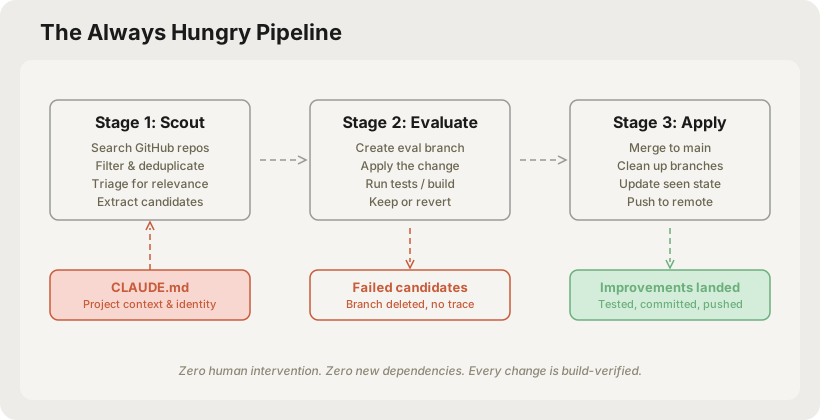
Scout — The agent reads your CLAUDE.md, builds a project profile, searches GitHub for repos in your domain, and triages them for relevance. It tracks what it's already seen so repeated runs only discover new content.
Evaluate — Each candidate gets its own git branch. The agent applies the change, runs your build/tests. Pass → keep. Fail → delete the branch, no trace. Your test suite is the immune system.
Apply — Passing candidates merge to main with clear commit messages pointing to the source repo. Branches cleaned up. State updated. Pushed.
You come back and find your project has evolved.
A Real Run
I ran /always-hungry on this blog before writing this post.
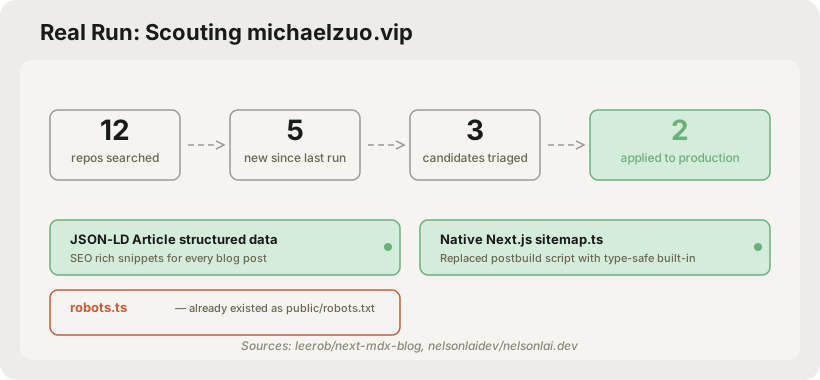
12 repos scanned. 5 new since last run. 3 candidates triaged. 2 applied:
JSON-LD Article structured data (from leerob/next-mdx-blog) — Added BlogPosting schema to every post page using metadata that already existed in the codebase. Search engines can now understand post structure for rich snippets.
Native Next.js sitemap.ts (from leerob/next-mdx-blog) — Replaced a postbuild Node.js script with Next.js's built-in app/sitemap.ts. Type-safe, framework-integrated, old script deleted.
One candidate (robots.ts) was dropped — the agent checked and found public/robots.txt already existed. Both applied changes were independently build-verified.
Design Principles
- Look outward. Improvements come from real repos, not LLM reasoning in a vacuum.
- No new dependencies. The project absorbs patterns, not packages.
- Build-gated. Every change must pass your test suite.
- Stateful. Remembers what it's seen. Each run finds genuinely new content.
- Surgical. Targeted files only. No rewrites. No scope creep.
Try It
Grab it from GitHub, then:
/always-hungry
The project reads its own CLAUDE.md, builds its identity, observes its ecosystem, experiments, and absorbs. Run it once, or run it every week. The improvements compound.
/always-hungry --scout-only    # observe only, don't experiment
/always-hungry --dry-run       # show profile without acting
/always-hungry --show-last-run # see what it learned last time
The Bigger Idea
We're used to thinking of software as something we build and maintain. Always-hungry inverts that. The project evolves by continuously learning from its ecosystem.
The world moves fast. And your project — even while you sleep — can stay always hungry, learning the best ideas from across the globe.